
The Physics of Balance: Why CAD-Driven Design is the Secret to the Perfect Tow
The Confidence of a Stable Platform
Stability is an Engineered Outcome
True towing confidence comes from a platform that behaves exactly as you expect, regardless of the terrain. Sway is often discussed as an unavoidable risk, but in reality, sway is simply a symptom: it is the result of mass distribution, yaw inertia, and a centre of gravity that was never properly calculated.
At Rhinomax, we do not design our Australian made hybrid campers from the inside out. We do not build a floorplan and then try to fix the balance later by shifting a spare wheel. We build to a physics equation, starting with the heaviest items first.
Much like high-performance automotive engineering, where stability is a mission-critical necessity, a Rhinomax is designed as a perfectly balanced platform. We establish a Centre of Gravity (CoG) target in CAD before the first piece of steel is ever cut. Water tanks and batteries are hundreds of kilograms of mass that define how the platform handles. We place them as low as practical and as close to the axle as possible to ensure the platform remains planted.

1) Polar Moment of Inertia: The Seesaw Logic
Most people understand weight, but few people understand the consequence of where that weight sits. Polar Moment of Inertia is the measure of how resistant an object is to rotation. In towing, this refers to yaw: the trailer rotating left and right.
Think of it as the difference between holding a long pole with weights at the very ends versus weights in the middle. Both poles weigh the same, but the mass at the ends is far harder to stop once it starts moving. This is the pendulum effect. By centralizing mass near the axle, disturbances die out faster and the platform stays composed. When engineers calculate the moment of inertia (I) about the yaw axis, they use this formula:
In practical terms, what does this actually mean for your tow?
- I represents the trailer's resistance to swaying.
- m is the mass of the item you are loading (like a full water tank or a heavy toolbox).
- r is the distance of that item from the axle.
Because the distance (r) is squared in the math, placing a heavy item far away from the axle heavily multiplies its negative effect on your stability. By minimizing the distance of every heavy component from the pivot point, we ensure the trailer cannot start steering the tow vehicle.
2) The Water Weight Variable
Water is the most dynamic load in any camper because it changes constantly. If your water tanks are at the rear, the balance of the camper shifts every time you use the tap. This creates an unpredictable tow that changes across the day. Predictability is the foundation of safety.
Axle-Centric Tank Placement
Rhinomax water tanks are positioned directly over, or slightly forward of, the axle. Because the moment arm is short, the handling characteristics remain almost identical whether your tanks are 100 percent full or nearly empty. Whether you are traversing a desert or cruising the highway, the platform stays consistent.
3) Towball Weight is a Requirement, Not a Suggestion
We target towball weight at approximately 10 percent as a deliberate design requirement. This provides a meaningful stability margin without creating an unnecessary load penalty on your vehicle. But hitting that number on delivery day is only half the job.
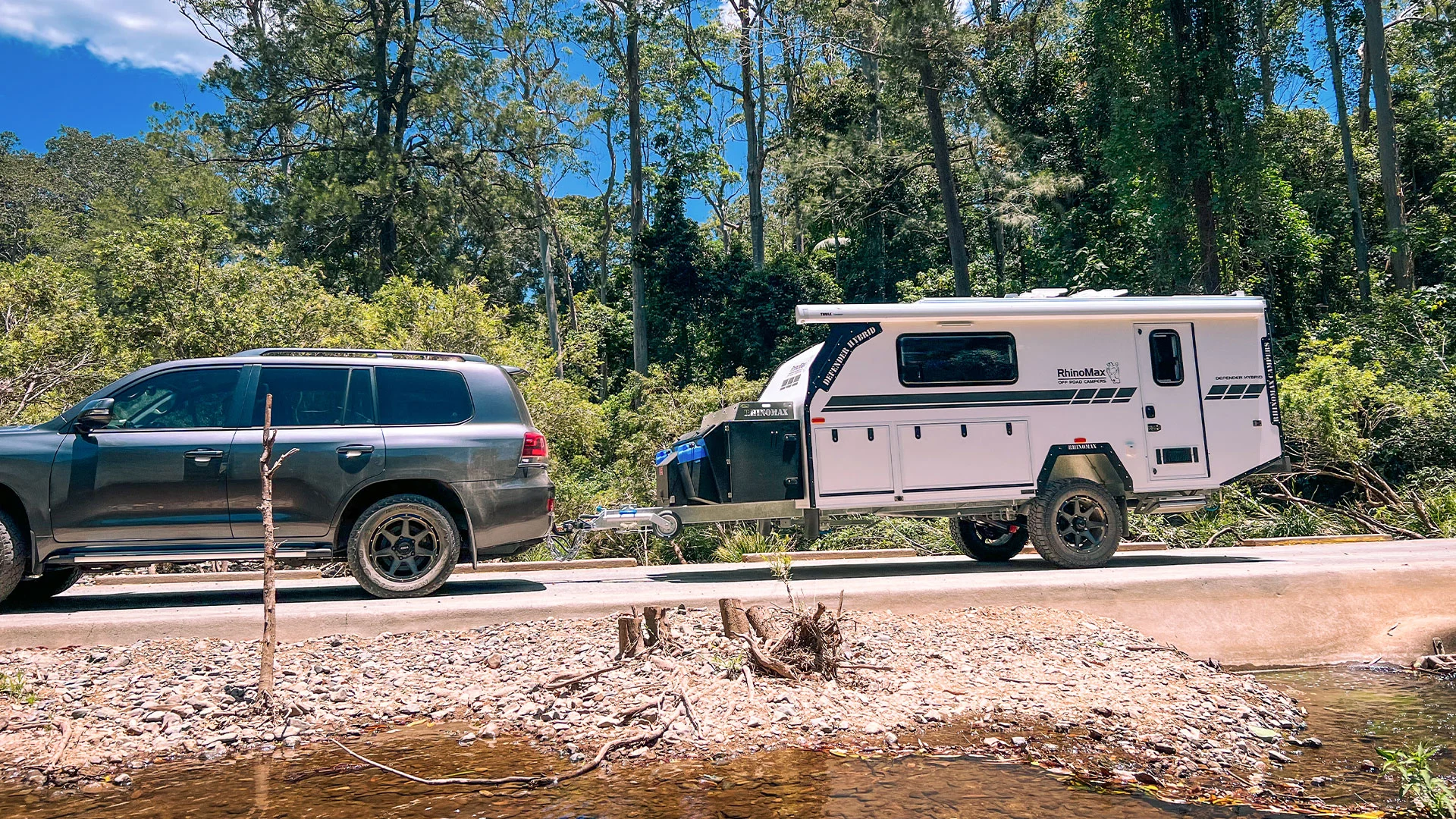
A Rhinomax is engineered so you can use the front storage box for meaningful gear without destabilising the platform. Many campers are balanced in one configuration and become sensitive the moment you load them for a real trip. We build our mass models around real-world loading scenarios: including full tanks, food supplies, and gear in the front box.
4) CAD vs. Guesswork: Why We Calculate
In engineering, hope is not a design method. We use 3D modelling and weight distribution sheets to track every component from the beginning. Adding mass to the rear, like a spare wheel, is not a free addition. It is a systemic change. If a design includes rear-mounted mass, we reconfigure the entire weight profile of our Australian made hybrid camper to compensate. We do not just add accessories; we alter the dynamics.
5) Low Centre of Gravity: The Anti-Roll Factor
Balance is vertical as well as lateral. A high centre of gravity makes a camper feel top-heavy and nervous on off-camber tracks. By keeping the heaviest items, such as batteries, water, and chassis steel, low and centralized, we reduce the roll moment. This is the same philosophy used in off-road motorsport to keep vehicles stable on the most hostile terrain.
The Payload & Balance Pro Tip
Next time you are at a show, look past the interior finishes. Look underneath to see where the water tanks are located, and then ask the question most showrooms are not ready for:
“How much does the towball weight change as the tanks empty, and how does packing our real-world gear affect the trailer's handling?”
If they cannot confidently explain their load ratings and how the platform maintains its balance when fully packed, you are looking at a guess. At Rhinomax, we engineer for predictable stability, no matter how you load it.